AIP87 Series Single-Phase AC/DC Power Meter

AIP87 Series Single-Phase AC/DC Power Meter

2-产品
Products

AIP87 Series Single-Phase AC/DC Power Meter

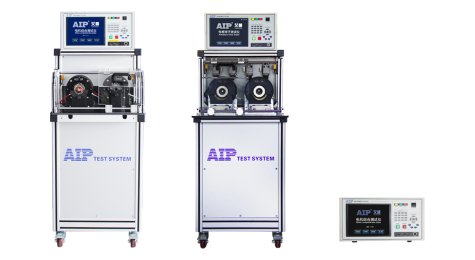
AIP87 Series single-phase AC/DC power meter measures voltage, current, power, frequency and electrical energy with fast 0.25 s updates, RS-232/RS-485 and MODBUS communication.

Key Features

■ AC/DC universal wide-range design, DC~1kHz bandwidth, with stronger load adaptability.

■ Reliable, stable, small in size, and lightweight.

■ Fast measurement speed, with a refresh rate as fast as 0.25 seconds.

■ Voltage and current ratio setting functions allow for easy expansion of the measurement range.

■ Voltage, current, and power over-limit audible and visual alarm functions meet the need for rapid on-site identification of abnormal products.

■ Standard configuration includes an RS-232 or optional RS-485 serial communication port, supporting MODBUS communication for easy test automation.

■ Optional switch I/O function to realize remote control input and alarm signal output.


Technology

Test Speed: As fast as 0.25 seconds


Specification


ModelAIP 8721PAIP 8711PAIP 8721JAIP 8711J
Measurement ChannelSingle phase
Measurement parametersVoltage U, Current I, Active Power P, Reactive Power Q, Apparent Power S, Power Factor λ, Phase Angle Φ, Voltage Frequency f, Electrical Energy Wh, Electrical Energy Timing Time
Wiring usageA non-removable common ground shorting tab is provided between the voltage/current terminals, supporting only the internal connection method of the ammeterNo short-circuit breaker; supports four-wire method for long-distance measurement wiring.
Input impedanceVoltage: Approximately 2MΩ
Current: Approximately 4mΩ (20A range), approximately 80mΩ (1A range)
Full-scale peak factor1.6
Voltage Rated Range600V
Voltage accuracy range1V~600V
Rated current range1A/20A (AC/DC)20A (AC/DC)1A/20A (Exchange)20A (Exchange)
Current accuracy range1mA~1A/20A20mA~20A1mA~1A/20A20mA~20A
Voltage/current accuracy*

±( 0.1% × displayed value + 0.1% × range)

(DC, 45Hz≤f≤1kHz)

±( 0.1% × displayed value + 0.1% × range)

(45Hz≤f≤65Hz)
Active power measurement range

8722: 2.2mW (PF=0.01)~4.4kW (PF=1)@220V

8721: 44mW (PF=0.01)~4.4kW (PF=1)@220V

8712: 22mW (PF=0.1)~4.4kW (PF=1)@220V

8711: 0.44W (PF=0.1)~4.4kW (PF=1)@220V
Active power accuracy*

± ( 0.1% × displayed value + 0.1% × range)

(DC, 45Hz≤f≤1kHz)

±( 0.1% × displayed value + 0.1% × range)

(45Hz≤f≤65Hz)
Power factor accuracy range±(0.01~1)±(0.1~1)
Frequency measurement rangeDC, 45Hz≤f≤1kHz45Hz≤f≤65Hz
Frequency measurement accuracy±(0.1% × displayed value) (Voltage amplitude should be greater than 10% of the range)
Active power resolution0.01W
Power factor resolution0.001
Electric energy range0~99999MWh
Electrical energy accuracy± ( 0.2 % × displayed value)
Expanded uncertaintyUncertainties for voltage, current, power, frequency, and electrical energy are all ≤0.30%.
Electricity timing999 hours 59 minutes 59 seconds
Electricity timing accuracy±(0.05% × displayed value)
Voltage/current ratio0.1~1000.0
Data update cycle0.25, 0.5, 1 [s]
Alarm functionFive groups of voltage, current, power upper/lower limits, and threshold settings.
Control InterfaceRS-485 (or RS-232), switch function (optional)
External dimensions213mm (W, front plastic) × 88mm (H, front plastic) × 386mm (D, including terminal blocks)
Opening size210(W)×85(H) mm
Foot height15 mm
Total weightApproximately 3kg
Overall power consumptionApproximately 10VA

*[Accuracy conditions]

  Preheating: at least 15 minutes after power-on.

  Temperature: 23±5℃, Humidity: 30%~75%RH, Power supply: AC 100V~ 240V , 45 ~65Hz

  Temperature coefficient: When the temperature range is 5~18℃ or 28~40℃, the error increases by ± (displayed value × 0.06 % )/℃.

@ [Ammeter Internal Connection Method]

  A voltmeter directly measures the supply voltage, and its two ends are connected across the product under test and the ammeter. This introduces a voltage division measurement error due to the internal resistance of the ammeter.

# [Four-line method]

  When measuring at long distances (the distance between the measuring instrument and the product under test is relatively far, usually more than 10 meters), in order to eliminate the voltage drop on the test lines, a four-wire connection method (two voltage lines and two current lines) can be used to directly lead the voltage test lines from both ends of the product under test for test wiring.